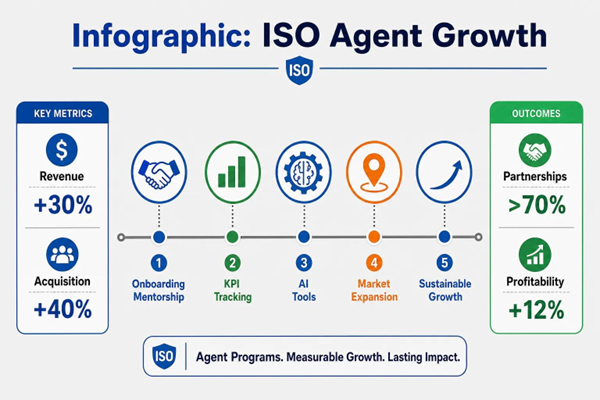
Success stories from agent programs show how Independent Sales Organizations (ISOs) scale revenue and strengthen client relationships. This collection of case studies and performance data highlights onboarding methods, core metrics, and recent innovations that consistently drive ISO growth. Read on for practical tactics—onboarding best practices, KPI frameworks, and tech tools—that ISOs can apply to build sustainable, agent-driven expansion.
Agent programs have become central to many ISOs’ growth strategies. By partnering with experienced agents, ISOs extend market reach, accelerate sales, and deepen customer relationships. These case studies reveal how targeted onboarding, consistent performance tracking, and tech-enabled workflows combine to create measurable results and long-term partnerships.
Key Takeaways
Agent programs expand market coverage and drive measurable ISO growth.
Typical growth indicators include revenue gains around 30% year-over-year, client acquisition increases up to 40%, and retention boosts of 20–25%.
Strong agent partnerships often translate to longer engagement windows, higher margins, and competitive advantages from localized market knowledge.
Onboarding that includes mentorship, continuous training, and engagement initiatives improves agent retention and sales performance.
Automation and AI—CRMs, learning platforms, and chatbots—streamline onboarding and ongoing agent management.
Success is reflected in metrics such as conversion rates, agent productivity, and client retention exceeding 85%.
Recent innovations include AI-driven communications, localized campaigns, cross-industry partnerships, and accelerated digital transformation.
Structured data and visual assets—graphs, infographics—help present results clearly and improve search visibility.
Regular KPI monitoring and smart internal linking strengthen agent programs and support long-term ISO growth.
How Have Successful Agent Programs Driven ISO Business Growth?
Well-run agent programs let ISOs enter new markets quickly while leveraging agents’ local relationships and industry expertise. These collaborations increase sales opportunities, boost topline revenue, and create more resilient customer networks that support repeat business and referrals.
What Are Key ISO Growth Metrics Documented in Case Studies?
Common metrics that indicate strong ISO performance include:
Revenue Growth: Case studies often show ISOs with structured agent programs realizing revenue increases of 30% or more annually.
Client Acquisition Rates: Effective programs can lift acquisition rates by as much as 40%, enabling fast geographic or vertical expansion.
Retention Improvement: Personalized engagement and consistent support typically yield retention improvements in the 20–25% range.
Which Agent Partnership Outcomes Demonstrate Tangible Business Benefits?
Top agent partnerships deliver clear commercial advantages, including:
Extended Partnership Durations: Many programs report partnership retention rates over 70%, signaling durable, trust-based relationships.
Monetary Benefits: Companies often see margin improvements of 10–15% after optimizing agent engagement and operations.
Competitive Advantages: Agents’ local insights enable ISOs to tailor offerings and pricing, resulting in smarter go-to-market decisions and stronger positioning.
What Best Practices Enhance Agent Onboarding in Top Agent Programs?
Onboarding sets the tone for agent performance. High-performing programs use structured, hands-on onboarding that blends mentorship, practical training, and early engagement to accelerate productivity and loyalty.
How Do Innovative Onboarding Techniques Improve Agent Retention?
Smart onboarding keeps agents engaged and productive. Proven practices include:
Mentorship Programs: Pairing new agents with experienced mentors shortens ramp time and builds confidence.
Continuous Training Opportunities: Ongoing product and sales training keeps agents competitive and informed.
Engagement Activities: Regular team sessions and recognition programs foster belonging and commitment.
Which Automation and AI Tools Are Shaping 2025-2026 Onboarding?
Automation and AI cut friction from onboarding and management. Core tools include:
CRM Systems: Centralize agent communication, pipeline tracking, and performance analytics.
Learning Management Systems: Deliver scalable, on-demand training that agents can follow at their own pace.
AI Chatbots: Provide instant answers to common questions, freeing managers to focus on strategic coaching.
Which Performance Metrics Define Success in Agent Programs?
Tracking the right metrics lets ISOs measure impact and iterate. The most telling indicators are revenue per agent, conversion rates, and long-term client retention.
How Do Revenue Growth and Client Retention Metrics Reflect Program Effectiveness?
Revenue and retention metrics show whether an agent program is delivering sustainable value. Monitoring revenue per agent helps identify top performers and training needs, while client retention rates above 85% typically signal strong customer engagement practices.
What Role Do Agent Program KPIs Play in Driving ISO Partnerships?
KPIs guide strategic decisions across agent networks. Focus areas include:
Critical KPIs: Sales conversion, agent productivity, and response times to client requests are core to operational health.
Data Tracking Systems: Automated reporting ensures timely insights and easier benchmarking.
What Are Recent Agent Program Innovations Impacting Success in 2025-2026?
New approaches are reshaping agent programs—improving reach, efficiency, and agent experience.
How Is AI Enhancing Agent Program Communication and Management?
AI powers smarter communication and targeted support. Typical benefits include:
Improved Communication Strategies: Automated notifications and personalized outreach keep agents informed and engaged.
Efficient Management Processes: AI-driven insights identify skill gaps and recommend tailored training paths.
Which Market Expansion Strategies Are Emerging in ISO Agent Collaborations?
Emerging strategies include:
Localized Marketing Approaches: Agents enable campaigns tailored to local preferences and behaviors.
Cross-Industry Partnerships: Partnerships outside core verticals open new channels and customer segments.
Digital Transformation: Using digital tools to reach customers across channels improves accessibility and conversion.
How Do Case Studies and Success Stories Showcase Agent Program Achievements?
Case studies make results tangible—connecting KPIs, processes, and human stories to show exactly how programs succeed and where others can replicate those wins.
What Structured Data and Schema Markup Best Highlight Agent Program Outcomes?
Structured data helps content stand out and communicates achievements to search engines by:
Improving Search Visibility: Proper schema increases the chance of rich results and higher click-throughs.
Highlighting Key Metrics: Marking up outcome figures (revenue, retention, acquisition) makes them more visible in search snippets.
Which Visual Tools Like Graphs and Flowcharts Best Support Agent Success Documentation?
Visuals clarify performance and process. Useful tools include:
Graphs: Track sales trends and agent performance over time.
Flowcharts: Map onboarding and operational workflows to reveal bottlenecks.
Infographics: Summarize key statistics and case study highlights for stakeholders.
How Can ISOs Leverage Agent Programs for Sustainable Long-Term Growth?
To build lasting growth, ISOs should formalize agent engagement, measure impact rigorously, and invest in systems that scale both operations and agent success.
What Internal Linking Strategies Improve Content Authority for Agent Programs?
Anchor Text Strategies: Use descriptive anchors to connect related resources and improve context.
Linking Frameworks: A clear linking structure helps search engines and users navigate related content.
Page Authority Building: Interlink high-value pages to pass authority and lift discoverability.
Which KPIs Should ISOs Monitor to Adapt and Optimize Agent Partnerships?
Monitor a focused set of KPIs to stay responsive:
KPI Importance: Prioritize metrics that directly impact revenue and retention.
Monitoring Techniques: Run regular performance reviews and dashboards for near-real-time visibility.
Adjustment Strategies: Use data-driven playbooks to iterate compensation, training, or territory assignments.
Frequently Asked Questions
1. What is the impact of agent programs on client satisfaction?
Agent programs usually improve client satisfaction by enabling personalized service and faster responses. Local agents understand customer needs and can resolve issues quickly, building trust and long-term loyalty. That direct contact often translates to higher satisfaction scores and repeat business.
2. How do ISOs measure the success of their agent programs?
ISOs use a mix of quantitative and qualitative measures: revenue growth, client acquisition, retention figures, conversion rates, and profitability—paired with agent and customer feedback. Regular benchmarking and reporting help detect trends and guide optimization.
3. What role does technology play in enhancing agent programs?
Technology is central: CRMs, LMS platforms, analytics, and automation reduce manual work and surface actionable insights. These tools enable faster onboarding, clearer performance tracking, and more consistent agent support.
4. Are there specific challenges faced by ISOs when implementing agent programs?
Common challenges include ensuring consistent training, maintaining clear communication across dispersed teams, and aligning agent incentives with company goals. Overcoming these requires structured onboarding, reliable communication channels, and transparent performance metrics.
5. How can ISOs attract high-quality agents to their programs?
Attract top agents by clearly communicating the value proposition: competitive compensation, comprehensive training, strong operational support, and visible growth opportunities. Leverage testimonials, referrals, and targeted recruiting to reach experienced candidates.
6. What training methods are most effective for new agents?
Blended training works best: mentor-led coaching, interactive workshops, and self-paced e-learning. Practical role-play, product demonstrations, and regular assessments help cement skills and shorten time to productivity.
7. How do successful agent programs adjust to market changes?
High-performing programs stay nimble by monitoring market signals, soliciting agent feedback, and running rapid pilots. Regular data reviews and a culture that rewards innovation allow quick pivots and updated go-to-market tactics.
Conclusion
Agent programs are a proven channel for ISOs to scale revenue, improve retention, and win local market advantage. The most successful programs combine structured onboarding, clear KPIs, and the right technology stack. Explore these best practices to strengthen your agent network and drive long-term ISO growth. Contact High Risk Pay Merchants today.