High‑Risk vs. Standard Merchant Accounts: Clear differences in payment processing, underwriting, and costs

Choosing the right merchant account changes how you accept payments, how underwriting treats your business, and what you pay. This guide breaks down the practical differences between high‑risk and standard merchant accounts — from approval steps and fees to compliance and chargeback management — so you can decide which setup fits your business needs.
High‑risk merchant accounts are built for businesses that banks and processors view as having elevated fraud, chargeback, or regulatory risk. These accounts can be harder to get and usually come with stricter terms. Standard merchant accounts suit businesses in lower‑risk industries and typically offer faster approvals and lower fees. Knowing these basic definitions helps you compare the two and pick what fits your business model.
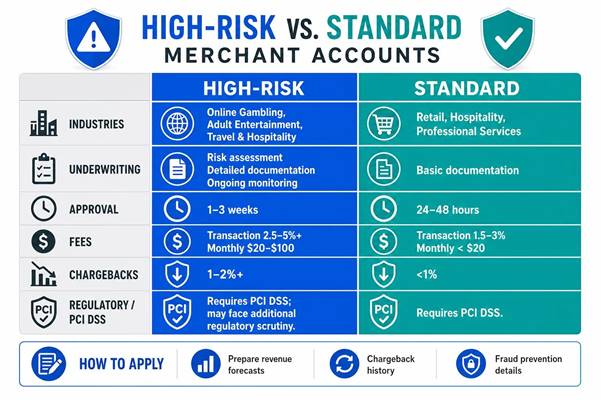
The main distinction is the perceived risk tied to the business activity. Sectors like online gambling, adult entertainment, and some travel operators often land in the high‑risk category because they face higher fraud exposure and chargebacks. Standard accounts are more common in retail, hospitality, and professional services, where sales patterns and customer disputes are more predictable.
Common examples of high‑risk industries include:
These examples show how industry dynamics affect the merchant solution you’ll need to manage transactions effectively.
Underwriting differs by risk profile. Providers evaluate business history, credit, transaction patterns, and compliance practices. For high‑risk applicants, underwriting digs deeper — expecting more documentation, clearer fraud controls, and stronger evidence of operational stability.
Approval workflows vary. For high‑risk accounts, providers typically follow these steps:
Standard accounts usually involve a simpler review, focusing on basic documents, credit checks, and proven transaction history.
Key factors that affect approval include:
Maintaining solid financials and transparent operations improves your chances with any provider.
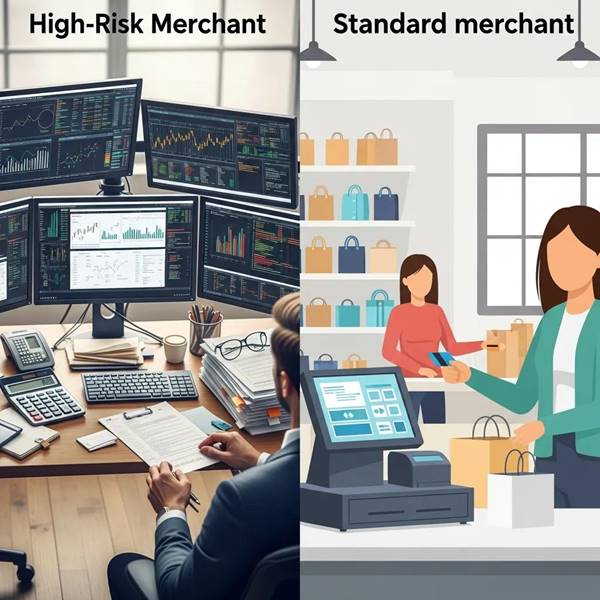
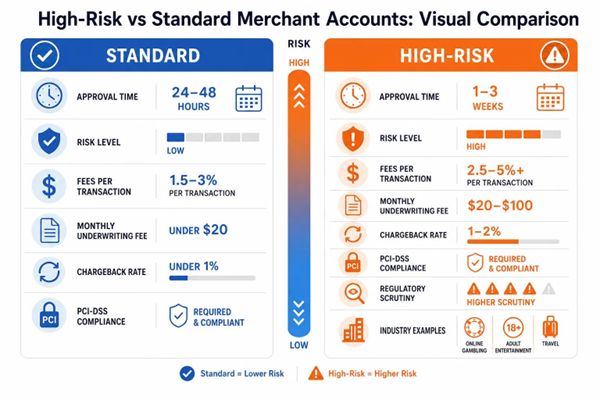
Fee structures reflect the underlying risk. High‑risk accounts typically carry higher transaction fees, possibility of rolling reserves, and larger monthly charges. Standard accounts, aimed at lower‑risk merchants, usually have lower rates and fewer contingencies.
Typical ranges are:
Exact pricing depends on your processor, volume, and the controls you have in place to limit chargebacks and fraud.
Your choice of processor matters. High‑risk businesses often need specialized processors that provide enhanced risk management and monitoring — and those services add cost. Standard merchants can usually choose from a wider pool of cost‑competitive providers with fewer special requirements.
High‑risk merchants require stronger defenses. Because their chargeback and fraud exposure is higher, they must use more sophisticated tools and stricter operational controls.
Chargeback rates tend to be higher for high‑risk merchants — often 1%–2% or more — which can trigger additional fees and monitoring. Standard merchants typically see lower rates, often under 1%, making it easier to keep processing costs down.
Effective prevention measures include:
Combining these tools with clear refund policies and transparent customer communication reduces disputes and protects margins.
Compliance rules change often, but both account types must meet baseline standards. Staying current with requirements avoids penalties and protects customer data.
All merchants must follow PCI DSS rules to secure cardholder data. Core measures include:
High‑risk merchants often face additional scrutiny from networks and processors, so rigorous controls are essential.
New regulations have tightened monitoring and reporting, increasing the emphasis on transaction surveillance and fraud prevention — especially for high‑risk sectors. Staying proactive about compliance helps you avoid surprises and keeps your processing relationship stable.
Applying requires the right paperwork and realistic timelines. Knowing what’s expected speeds approval and reduces delays.

Underwriting typically follows these steps:
Preparing complete documents and clear explanations of your operations reduces review time and helps secure better terms.
The growing volume of data in insurance and finance makes advanced methods for profiling and underwriting increasingly important.
Customer Risk Profiles for Underwriting: Knowledge Graph Approach
ABSTRACT: As insurance and financial services scale to broader markets, the data needed to assess a customer’s mortality or risk profile has grown exponentially. Traditional, manual underwriting struggles to keep pace and often lacks personalization, consistency, and explainability. This research identifies challenges such as handling missing data, adopting data‑driven approaches, and ensuring model transparency. To address these problems, the study proposes an Underwriting Knowledge Graph (UKG) combined with a multi‑label classification model that integrates customer data with existing underwriting rules and explainable exclusion codes to produce personalized risk profiles.
Study: Approaches to developing customer risk profiles for underwriting using knowledge graphs and multi‑label classification — K.V. Nguyen, 2023
Approval timeframes vary: standard accounts often approve within 24–48 hours, while high‑risk applications can take one to three weeks depending on documentation and review complexity.
Knowing the difference between high‑risk and standard merchant accounts helps you choose the best path for your business. The right account affects pricing, approval chances, and compliance responsibilities. Review High Risk Pay Merchant resources to find a merchant solution that matches your industry, volume, and risk profile then take the next step to optimize your payment processing.