
Digital currencies are reshaping how money moves online and creating practical payment options for merchants labeled as high risk. For businesses shut out of traditional banking—whether by industry stigma or perceived liability—crypto payments offer an alternative path to accept customer funds securely and efficiently. This article explains the obstacles high‑risk merchants face, the payment solutions available, and the regulatory considerations to keep operations compliant and resilient. With a clear view of how blockchain works, merchants can tighten security and reach more customers.
We’ll walk through the specific hurdles high‑risk merchants encounter, show how crypto payment gateways solve real problems, and summarize compliance essentials. You’ll also find fraud prevention tactics, guidance on useful altcoins, and examples that illustrate successful crypto adoption in high‑risk verticals.
High‑risk merchants confront several hurdles when adding crypto as a payment option. These stem from both the nature of their industries—gaming, adult services, certain e‑commerce niches—and the inherent traits of digital currencies, like volatility and evolving regulation. The combination creates operational, compliance, and reputational risks that require deliberate management.
High‑risk merchant accounts expose businesses to higher instances of chargebacks, reversals, and fraud. Crypto’s digital format can amplify these exposures if controls are weak. That said, many risks are manageable through comprehensive risk assessments, layered security, and strong compliance programs. Real‑world cases show that without these safeguards, operational friction and regulatory constraints can slow growth.
Cryptocurrency Financial Risks and Management Strategies
The rapid emergence of cryptocurrencies has transformed global financial ecosystems, offering decentralized and innovative means of transaction and investment. However, this digital revolution has also introduced complex financial risks that challenge traditional risk management frameworks. This study explores the evolving landscape of financial risk management in the age of cryptocurrency, aiming to identify major risk categories—such as market volatility, cyber threats, regulatory uncertainty, and systemic vulnerabilities—and assess the effectiveness of current mitigation strategies. Financial Risk Management In The Age Of Cryptocurrency, 2025
The study reinforces that high‑risk merchants must map and mitigate crypto‑specific risks to build a sustainable payments strategy.
Blockchain delivers advantages that can lower processing risk. Its decentralized ledger creates verifiable transaction records, which enhances transparency and makes disputes easier to investigate. Crypto also often means lower processing fees and faster settlement times—both important for high‑risk businesses that operate on thin margins or across borders.
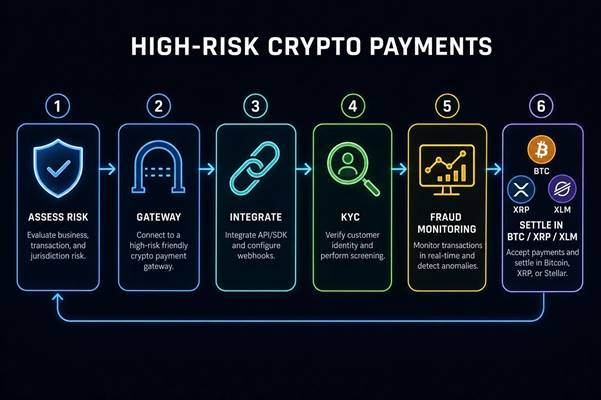

Crypto payment gateways are the operational backbone for merchants accepting digital assets. They handle transaction processing, currency conversion, settlement, and customer-facing flows—allowing high‑risk businesses to offer crypto payments without building custom infrastructure. The best gateways also bundle compliance tools and fraud controls to reduce operational headaches.
A dependable gateway for high‑risk merchants includes strong encryption, multi‑signature wallets, and layered fraud detection. It should offer clean, easy integrations with existing checkout systems, clear settlement options, and responsive support. Usability matters: simple merchant dashboards and transparent reporting reduce friction and speed troubleshooting.
Integration starts with choosing a provider that aligns with your security and compliance needs. Technical setup typically involves API configuration, testing payment flows, and confirming settlement preferences. Expect compatibility challenges with legacy systems and plan for compliance checks during onboarding. Thorough testing and continuous monitoring after launch are best practices to ensure reliability and performance.
Compliance is essential for high‑risk merchants accepting crypto. Regulators increasingly scrutinize digital asset activity, so businesses must operate with clear policies and documented controls to avoid penalties and service interruptions.
Meeting regulatory obligations typically requires robust KYC and AML processes. Effective onboarding includes identity verification, proof‑of‑address checks, and risk profiling. Payment processors and merchants must document these steps and keep records to demonstrate compliance to regulators and partners.
Practical compliance measures include scheduled audits, continuous staff training, and subscriptions to legal or compliance advisories that track regulation changes. Forming an internal compliance team or working with specialized providers helps maintain up‑to‑date controls and automate reporting where possible.

Stopping fraud is central to protecting revenue and reputation. While crypto introduces specific threats, blockchain tools and modern analytics provide effective defenses when used correctly.
Smart contracts can enforce terms and automate conditional settlements, reducing dispute windows. Transparent ledgers make it easier to trace suspicious flows, and machine‑learning fraud engines can flag anomalous behavior in real time. Combining these approaches provides a stronger defense than any single control alone.
Processors reduce chargebacks by improving transaction traceability and using authentication layers like wallet verification and transaction scoring. By blocking high‑risk transactions before settlement and providing clear evidence trails, processors help merchants significantly lower dispute rates.
Choosing the right payment stack matters. Merchants should balance liquidity, fees, settlement speed, and regulatory acceptance when deciding which coins and processors to support.
Evaluate providers on reputation, fee structures, supported coins, and customer service. Look for transparent pricing and clear settlement options—whether you want crypto payouts, fiat conversions, or hybrid models. Vendor reviews and case studies from similar industries are also useful decision inputs.
Networks like Ripple and Stellar emphasize fast, low‑cost cross‑border transfers and are often more practical for payments than some legacy blockchains. Stablecoins can reduce volatility risk by pegging value to fiat, while certain newer protocols offer programmable features that improve automation and security.
Adoption is growing as merchants see tangible benefits: faster settlement, easier cross‑border sales, and access to customers who prefer crypto. Examining case studies shows how tailored solutions can reduce costs and improve conversion.
Sectors such as online gaming and niche e‑commerce report higher conversion from crypto options, partly due to customer demand for privacy and lower fees. When combined with good UX and clear customer education, crypto payment options can expand market reach and improve margins.
Recent market indicators point to steady growth in crypto payments through 2026, driven by improved infrastructure and broader consumer acceptance. For high‑risk merchants, these trends suggest a growing opportunity to diversify payment options and reduce dependence on traditional acquirers.
Cryptocurrency offers faster settlements and often lower processing fees than traditional methods. It can reduce reliance on banks that decline high‑risk accounts and provide privacy features that attract certain customer segments. Crypto also enables easier cross‑border sales without complex currency conversions, helping merchants reach new markets.
Provide clear FAQ pages, short how‑to guides, and step‑by‑step checkout instructions. Use videos and simple visuals to explain how crypto payments work and why they’re secure. Promoting these resources through banners, emails, and social channels helps ease customer concerns and speeds adoption.
Common myths include that crypto is primarily for illicit use or is too volatile for commerce. In practice, reputable businesses accept crypto legitimately, and tools like stablecoins or immediate fiat conversion can mitigate volatility. Regulatory clarity is improving, and many firms now treat crypto as a legitimate payment option.
Tax treatment varies by jurisdiction, but many authorities view crypto as property or an asset, which carries reporting and capital gains implications. Accurate recordkeeping of transactions and consultation with a tax advisor experienced in digital assets are essential to remain compliant and avoid penalties.
Yes. Use hardware wallets for reserves, enforce two‑factor authentication across accounts, run regular software updates, and secure web traffic with SSL/TLS. Layer on AI‑driven monitoring to flag unusual activity and maintain incident response plans to act quickly if a breach occurs.
Aggregators simplify acceptance by consolidating multiple cryptocurrencies into a single integration, handling conversions, and offering compliance and fraud tools. This reduces technical and operational burdens and lets merchants focus on core business rather than crypto plumbing.
Consumer preferences for privacy, lower fees, and digital payment options are major drivers. As more customers expect crypto as a checkout choice, merchants in high‑risk spaces adopt it to meet demand, improve conversion, and build loyalty among crypto‑native users.
Accepting cryptocurrency gives high‑risk merchants practical benefits: faster settlements, lower costs, and broader access to customers who prefer digital assets. When paired with strong compliance, layered security, and clear customer communication, crypto payments can be a reliable alternative to constrained traditional banking. Explore High Risk Pay Merchant gateway options, prioritize risk controls, and start small to test what works best for your business—then scale with confidence.