Payment gateway selection and integration for high‑risk merchant accounts: a clear, practical guide to choosing secure
payment processors and getting them running smoothly.
Picking the right gateway matters more when you operate in a high‑risk industry or have credit challenges. This guide walks through the key factors, the step‑by‑step integration process, and the common obstacles high‑risk merchants face. You’ll get practical advice on security, compliance, pricing transparency, and the operational steps needed for a reliable setup — so you can choose wisely and integrate with confidence.
Key Takeaways
- high-risk merchant accounts need specialized gateways because of higher chargeback exposure and closer regulatory scrutiny.
- Strong security — encryption and PCI DSS compliance — is non‑negotiable for protecting payment data.
- Transparent pricing (clear transaction and monthly fees) helps manage cash flow and forecasting.
- Selecting a gateway means researching providers, completing detailed applications, and following integration guides.
- High‑risk merchants commonly face account shutdowns, fund holds, and limited processing limits.
- Effective fraud prevention uses real‑time monitoring, chargeback management services, and advanced detection tools.
- Responsive, knowledgeable customer support is essential for keeping merchant accounts stable under pressure.
- Compare processors by approval speed, fees, and features to find the best operational fit.
- Proactive chargeback reduction centers on clear pricing, strong customer communication, and fast resolution of disputes.
Key Considerations
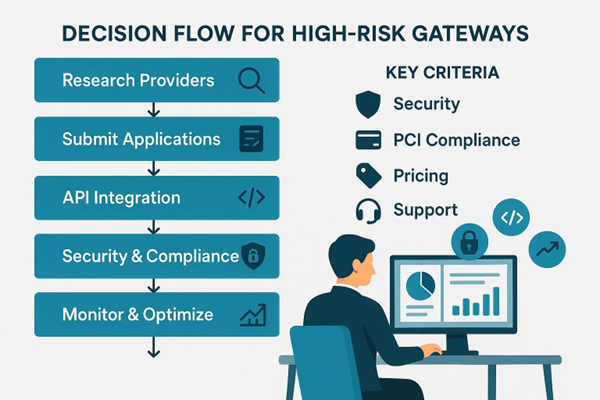
When choosing a payment gateway for a high‑risk business, prioritize solutions that match both your technical requirements and the risk profile of your industry. The right gateway reduces friction, protects revenue, and helps you stay compliant.
- Security Features: Choose gateways with end‑to‑end encryption, tokenization, and robust fraud detection to safeguard customer payment data.
- Compliance Requirements: Confirm the provider meets industry standards like PCI DSS so transactions are processed securely and audits are simpler.
- Transparent Pricing: Understand transaction rates, monthly fees, and any additional charges up front to avoid surprises that hurt your margins.
Adhering to international standards such as PCI DSS isn’t optional when you handle card data — it provides a baseline of technical controls that protect customers and your business.
PCI DSS Compliance for Payment Security
You can’t run a card‑accepting business without handling payment security, so the Payment Card Industry Data Security Standard (PCI DSS) is one of the first frameworks you must follow. Any organization that accepts payment cards must comply with PCI DSS as required by card brands. While PCI DSS is an industry standard rather than a national law, it’s comprehensive and technical — a solid foundation for any security program. National regulations may add additional protections for financial, health, and other personal data. This section summarizes key PCI requirements, common card threats, and core procedures merchants must follow.
Complying with the PCI DSS Standard, 2024
High Risk Pay specializes in matching high‑risk businesses and merchants with gateway providers and integration support. Our experience helps navigate the extra documentation and underwriting that come with higher‑risk profiles.
Implementation Steps
Integrating a gateway for a high‑risk merchant involves clear stages: research, application, and technical setup. Following a structured approach reduces delays and improves approval odds.
- Research Providers: Focus on processors that explicitly serve your industry. Read reviews, ask for merchant references, and check how they handle disputes and holds.
- Submit Applications: Prepare a complete application with business model details, transaction history, and risk‑mitigation policies to speed underwriting.
- Integration Process: After approval, follow the provider’s API or plugin instructions for secure integration, test transactions, and validation before going live.
The application process for high‑risk accounts is often more involved; High Risk Pay provides guidance to streamline documentation and technical steps.
What Are High Risk Merchant Accounts and Why Do They Need Specialized Payment Gateways?
High‑risk merchant accounts serve businesses that banks and mainstream processors view as higher risk due to their industry, chargeback history, or regulatory exposure. Specialized gateways work with underwriters who understand those risks and offer tools to manage them.
Because traditional merchant accounts may be unavailable or unreliable for these businesses, tailored gateways provide the infrastructure and risk controls needed to accept and process payments consistently and securely.
Challenges Faced by High‑Risk Businesses
High‑risk merchants face operational challenges that directly affect payment processing. Knowing these issues helps you choose a gateway that mitigates them.
- Account Shutdowns: Underwriters may close accounts if risk thresholds are exceeded, interrupting cash flow.
- Frequent Fund Holds: Processors sometimes hold funds while investigating activity, which can hurt liquidity.
- Limited Processing Capacity: Higher‑risk merchants may be capped on monthly or per‑transaction volumes, constraining growth.
The tradeoff in e‑commerce is clear: stricter risk controls reduce fraud but can frustrate merchants, while looser policies improve experience but increase exposure to losses.
Merchant‑Oriented Risk Control in E‑commerce
Balancing effective risk management with merchant satisfaction remains a core challenge. Tight controls reduce incidents but can drive merchant frustration; relaxed policies improve user experience but raise the odds of costly events. Adaptive, data‑driven risk strategies aim to optimize both outcomes.
Adaptive merchant-centric risk control via unbiased decision-making and dynamic optimization in e-commerce, X Liu, 2025
These realities make it essential to pick a gateway that understands your line of business and provides practical operational safeguards.
How to Choose the Best Payment Processors for High Risk Businesses?
Evaluating processors for a high‑risk business requires a clear checklist. Focus on operational fit, cost, and support.
- Pricing and Fees: Compare all fees — transaction, monthly, chargeback, and setup — so you can forecast costs accurately.
- Approval Speed: Faster underwriting gets you processing sooner; ask vendors about typical approval timelines for businesses like yours.
- Customer Support: Choose processors with dedicated, experienced support teams who handle high‑risk issues quickly and proactively.
Use those criteria to shortlist providers that align with your risk tolerance and growth plans.
Key Features and Fees Comparison of High Risk Payment Gateways
Gateways differ in features and price. Below is a straightforward comparison to help weigh tradeoffs for high‑risk merchants.
| Gateway Provider |
Key Features |
Transaction Fees |
Monthly Fees |
| High Risk Pay |
Fraud detection, PCI compliance |
2.5% + $0.30 per transaction |
$25 |
| Stripe |
Easy integration, customizable APIs |
2.9% + $0.30 per transaction |
None |
| Authorize.Net |
Advanced fraud detection, recurring billing |
2.9% + $0.30 per transaction |
$25 |
This side‑by‑side view highlights why both features and fee transparency should guide your decision.
Alternatives to PayPal for High Risk Merchants with Bad Credit
If PayPal isn’t an option, several processors accommodate higher‑risk profiles and imperfect credit.
- High Risk Pay: Focused on high‑risk accounts, offering underwriting and tailored onboarding for businesses with bad credit.
- Stripe: Flexible APIs and wide feature support; may work depending on industry and underwriting outcomes.
- Net: Robust payments features and fraud tools, suitable for many subscription and recurring models.
Evaluate each option against your compliance needs, chargeback history, and expected transaction volume.
What Are the Steps to Integrate a Payment Gateway for High Risk Merchants?
Integration follows a predictable flow: select, prepare, apply, implement, test, and launch.
- Choose a Payment Gateway: Pick a provider whose risk appetite and technical stack match your business model.
- Prepare Your Website: Ensure your site meets security requirements, supports SSL, and can handle the provider’s integration method.
- Submit Your Application: Provide complete documentation and risk mitigation policies to smooth underwriting.
Following this sequence helps prevent common delays and reduces the chance of post‑launch surprises.
Technical Overview: API Integration and Security Compliance
API integration links your platform to the processor for secure, automated transactions. Use tokenization and HTTPS for secure data flows, and validate webhooks and callbacks during testing.
Security compliance — particularly PCI DSS adherence — requires encryption, access controls, and periodic testing. Work with your provider to document controls and schedule regular audits to keep your environment compliant.
How to Manage Chargebacks and Fraud in High Risk Payment Processing?
Chargebacks and fraud directly affect revenue and underwriting status. A layered approach reduces risk and preserves merchant stability.
- Chargeback Management Services: Use specialists or platform services that dispute illegitimate chargebacks and document evidence efficiently.
- Fraud Detection Tools: Deploy tools that score transactions, flag anomalies, and block suspicious activity before settlement.
- Customer Support: Fast, clear customer service can resolve issues before they escalate into disputes.
Combining these tactics lowers dispute rates and strengthens your relationship with processors.
Effective Fraud Prevention Tools and Risk Management Strategies
Best practice is a mix of prevention, detection, and response tools tailored to your transaction patterns.
- Smart Transaction Control: Apply dynamic rules and velocity limits to reduce automated or anomalous transactions.
- Real‑Time Monitoring: Monitor transactions and merchant activity continuously to spot trends and intervene quickly.
- Chargeback Prevention Systems: Implement systems that proactively address chargeback triggers, like delivery confirmation and clear billing descriptors.
These measures help preserve revenue and lower operational risk.
Best Practices for Chargeback Reduction and Merchant Account Stability
Preventing chargebacks and maintaining account health requires consistent, customer‑focused operational habits.
- Transparency in Pricing: Clear billing descriptors and upfront pricing reduce customer confusion and dispute rates.
- Strong Customer Support: Prompt, helpful support resolves issues before they become disputes.
- Timely Tracking and Communication: Provide shipment tracking, delivery confirmations, and proactive notifications to customers.
Applied together, these practices make accounts more resilient and reduce the likelihood of processor intervention.
Frequently Asked Questions
What types of businesses are considered high‑risk for payment processing?
High‑risk businesses include industries with higher chargeback rates or regulatory exposure, such as adult entertainment, online gambling, travel, and certain subscription services. Merchants with a history of financial instability or those operating in emerging markets may also be classified as high risk. Knowing your classification helps you pick a compatible gateway and set realistic underwriting expectations.
How can high‑risk merchants improve their chances of getting approved for a payment gateway?
To improve approval odds, present a transparent business model, supply thorough documentation, and show proactive risk controls (e.g., chargeback management, refund policies, and fraud tools). Demonstrating consistent customer support and adherence to industry standards reassures underwriters and shortens the approval timeline.
What are the common fees associated with high‑risk payment gateways?
Expect transaction fees (commonly 2.5%–3.5% plus a fixed amount like $0.30), monthly account fees, and potential chargeback or reserve fees. Fee structures vary by provider and merchant risk profile, so factor all costs into your pricing and cash‑flow plans.
What role does customer support play in high‑risk payment processing?
Customer support is a critical operational asset: experienced support teams reduce downtime, help resolve disputes, and assist with underwriting or technical issues. For high‑risk merchants, fast and knowledgeable support can prevent minor problems from escalating into account closures or holds.
How can high‑risk businesses effectively manage chargebacks?
Manage chargebacks proactively by using dispute management services, deploying fraud detection, and maintaining transparent customer communication. Analyze chargeback data to identify common causes and update policies or flows to address them. Early intervention and clear evidence submission improve dispute outcomes.
What are the benefits of using specialized payment gateways for high‑risk merchants?
Specialized gateways offer underwriting tailored to higher‑risk industries, enhanced fraud tools, and flexible acceptance criteria. They often provide guidance on compliance and chargeback mitigation, making it easier to accept payments reliably despite a higher risk profile.
Conclusion
Choosing the right gateway is a strategic decision for high‑risk merchants. Prioritize security, clear pricing, and a provider who understands your industry. Use the steps and best practices outlined here to select and integrate a payment processor that keeps transactions secure, minimizes disruption, and supports your growth. Explore our resources or contact High Risk Pay for tailored guidance and integration support.